
Guest post
The Possibility of Life: Are we alone in the cosmos?
One of the most powerful questions we ask about the cosmos is: Are we alone?
In The Possibility of Life, author and science writer Jaime Green ponders this question â and many more…
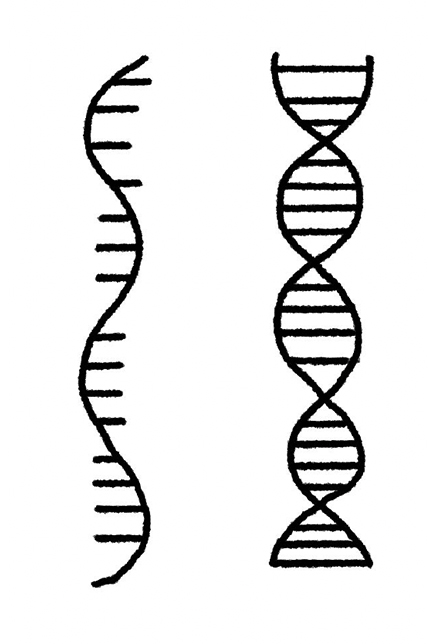
How does life begin?
- Was the early Earthâs chemistry crucial to the process?
- Or is life a subtler manifestation of information and energy?
- And can we ever hope to answer this question if we donât have a clear definition of what life even is?
What kinds of planets can be home to life?
- Earth seems especially habitable in almost every way, but what does life really need?
Water and starlight?
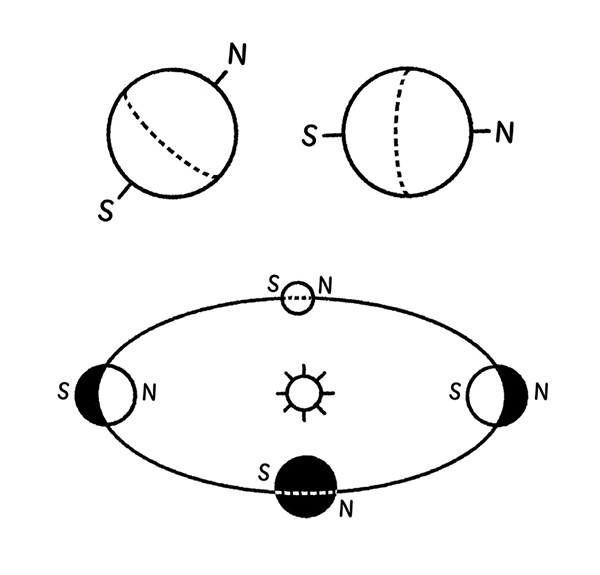
Stable seasons?
A moon and tides?
Plate tectonics?
The list starts to seem alarmingly long, but perhaps thatâs a failing of our imaginations.
Would alien life look familiar at all?
- Does evolution tend to solve the problems of life in familiar ways?
- Or is what we know on Earth a fluke, not the best solutions possible but just how things happened to work out here?
How can we imagine humanityâs far future?
Super-advanced aliens are a way to explore our hopes and fears for how technology will lead us into distant millennia.
- Will we continue to consume power, scaling up from planets to stars, or find a more peaceful way to persist?
- Or will humans, as we know it, disappear entirely, replaced by an utterly unimaginable world of AI?
Could we speak an alienâs language?
Itâs possible an alien language would be no more alien than a language from the other side of the globe.
- But what inconceivable grammars might be out there?
- Could aliens speak nonlinearly, simultaneously, or to senses we donât possess?
What might happen when we make contact?
We imagine aliens as saviors, enslavers, terrors, and everything in between.
They offer us community, perspective, or an external force against which to unify.
- But will we even know when weâve found them?
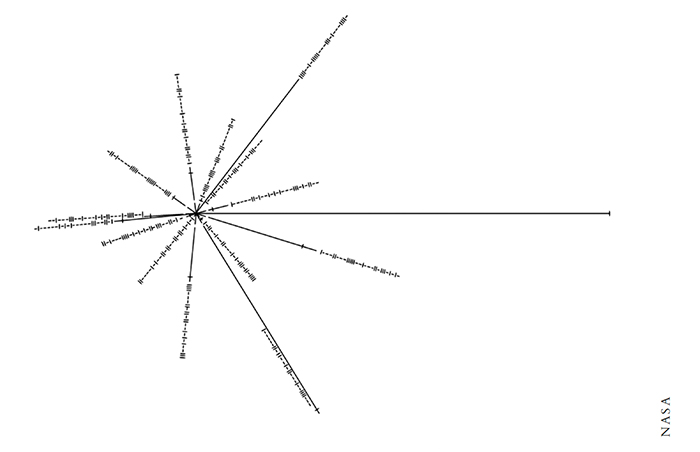
The symbol is called the pulsar map, a representation of our solar systemâs place in the galaxy, cross-referenced against the galactic center and fourteen pulsars, each represented by one ray of the starburst design. Here, their distance from Earth is shown in the length of their ray, the frequency of their pulse is shown by a dashed line, and their orientation in the galactic planeâthe galaxy being disk-shapedâis indicated by a little tick mark somewhere along the ray.
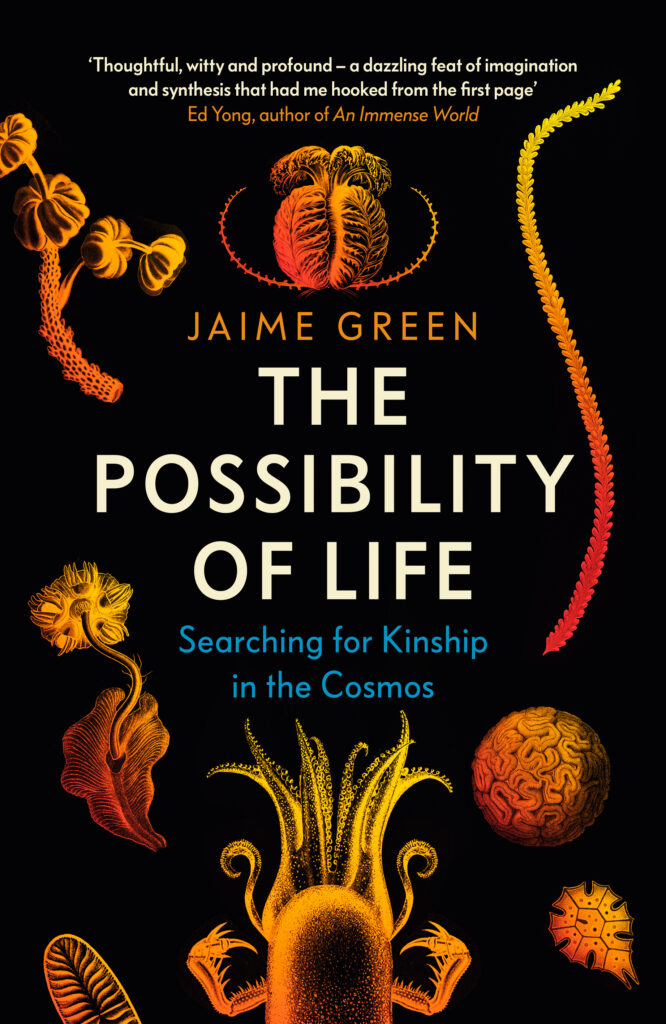
These intriguing and probing questions are explored by Jaime Green in her new book, The Possibility of Life.
Science meets sci-fi and pop culture in this fresh, exciting, deeply informed yet accessible perspective on the cosmos and our place in it.
Jaime’s book will appeal to readers of bestsellers such as An Immense World by Ed Yong, Forces of Nature by Brian Cox, Other Minds by Peter Godfrey-Smith and Entangled Life by Merlin Sheldrake.
A dazzling scientific and cultural adventure
âA fascinating and thoughtful reminder of the fact that we may not be alone. Highly recommendedâ â Jeff VanderMeer, New York Times-bestselling author of Annihilation
The Possibility of Life traces our scientific understanding of what and where life in the universe could be, from Galileo and Copernicus through to our current tracking of exoplanets in the âGoldilocks zoneâ, where life akin to ours on Earth might exist.
Along the way, Jaime Green interweaves insights from a long tradition of science fiction that uses imagination to extrapolate worlds, in turn inspiring scientists and their research.