Hello publishing professionals of the future! Duckworth Books is offering a 2-week publishing work experience in our Richmond office available on a rolling basis. The work placement is hybrid with two days in the office (Monday and Wednesday) and candidates are welcome to work from the office at their discretion.
The work placement provides a learning opportunity across departments, including: Editorial, Production, Sales, Marketing and Publicity. You will attend our meetings across departments to get a sense of the work that goes into creating, planning and promoting books. We will offer a mix of activities for candidates to work on such as reader reports, marketing research, sales outreach, press copy dispatch, events pitching, office admin, etc.
If interested in joining us for a 2-week publishing work experience, please send us your CV and available dates to Matt via info@duckworthbooks.com. Due to legal requirements, applicants must be 18 years of age or older.
To learn more about our history, discover our About Us page.
To learn more about our books, follow us on Instagram.
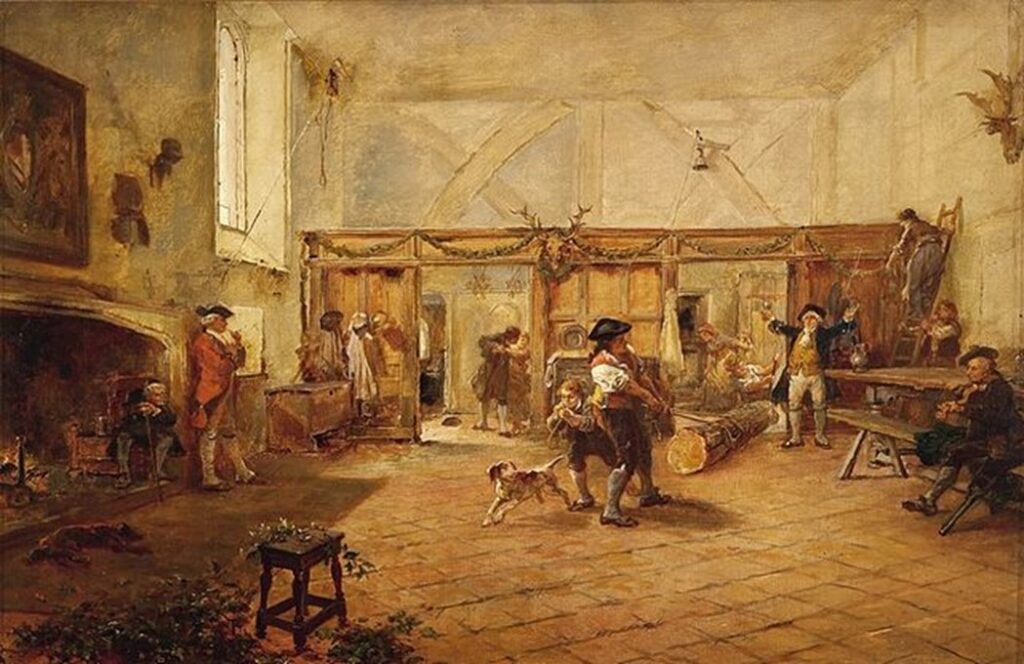
Party like it’s 1660 by following Anna Abney’s ‘9 Rules of Christmas’
Wassail!
It’s Christmas, and although it was suspended for 13 years, don’t let the haters put you off your celebrations. You might get called a wanton strumpet, heathen, papist or even the Antichrist by certain zealous Puritans, but ignore them. You may have forgotten a few traditions during the hiatus, but we’ve got you covered with Anna Abney’s 9 rules of Christmas.
1. Shop til you drop
Have your Christmas outfits made before the shops and markets close for the holiday. Now’s the time for new gowns, hats and handkerchiefs. Stock up on claret, sugar, cinnamon, ginger, nutmeg and cloves as they’re scented essentials to adorn your home.
2. Deck your halls
By Christmas Eve, you’ll need to have gathered plenty of holly, bay, rosemary and ivy for decorating the main rooms in your house as well as your public buildings. If you can’t find mistletoe locally, you might be able to buy it at market. Admire your evergreens with a wassail (a cup of spiced ale or cider).
3. Stoke your fires
Nothing says Christmas like a warm, blazing fire. Find a large piece of wood for the perfect Yule log and light it with a brand saved from last year’s log. It should be big enough to rekindle every day until Twelfth Night.
4. Work at your own risk
Prepare for time off to rest and play. Close up your business. Be aware that any shops or market stalls open on Christmas Day (as encouraged by the Puritans) may cause rioting. Mobs have been known to forcibly close shops that stay open during this period, chucking their wares up and down the streets.
5. Abandon your diet
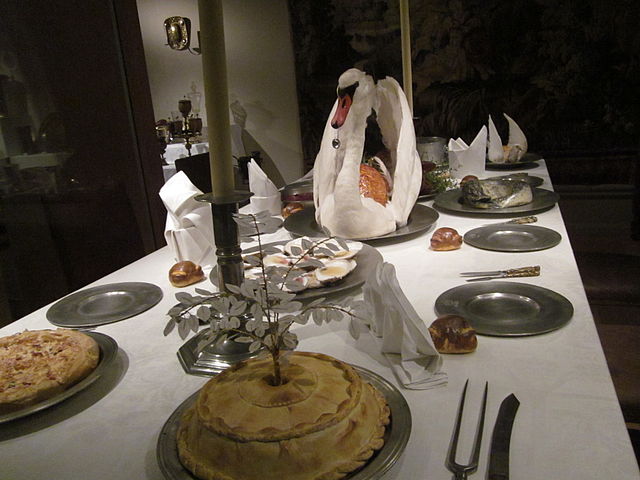
Hooray, it’s Christmas day! Advent fasting is over, now let’s eat, drink and make merry. Today’s menu should include brawn with sprigs of rosemary, plum-pottage and minced pies, as well as a roast swan if you really want to impress your guests (if you can’t get hold of swan, a turkey or a goose will do). Don’t forget the oysters and venison pasties. Decorate the table with piles of sweetmeats, dried fruits and sugar confections, including baked marzipan shapes studded with nuts and comfits, brushed with gold leaf. The wine and ale should flow freely. A trip to Church will do your soul good on this holy day. For this you should be sober and prepared for a sermon on the wrongheadedness of pagan celebrations.
6. Work hard, play harder
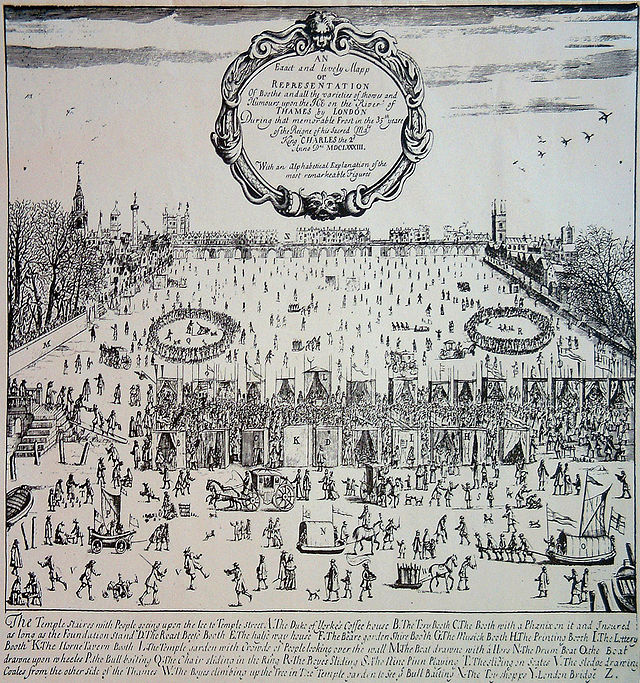
Get outside for some fresh air and exercise; traditional games are snowballing and football. Football is a bit rougher than you remember and you might end up with a broken leg and a bloody nose, but, according to London headmaster, Richard Mulcaster, ‘Footeball strengtheneth and brawneth the whole body, and by provoking superfluities downward, it dischargeth the head, and upper partes, it is good for the bowels, and to drive down the stone and gravel from both the bladder and kidneys.’ Just avoid ‘rash running & too much force’. If you’re lucky the Thames might freeze over and you can play your games there. For those with less hardy constitutions, there are plenty of indoor activities. Especially popular are dice and cards. The whole family can join in. Just make sure your guests don’t get carried away with gambling as the night could end in conflict.
7. Support the arts
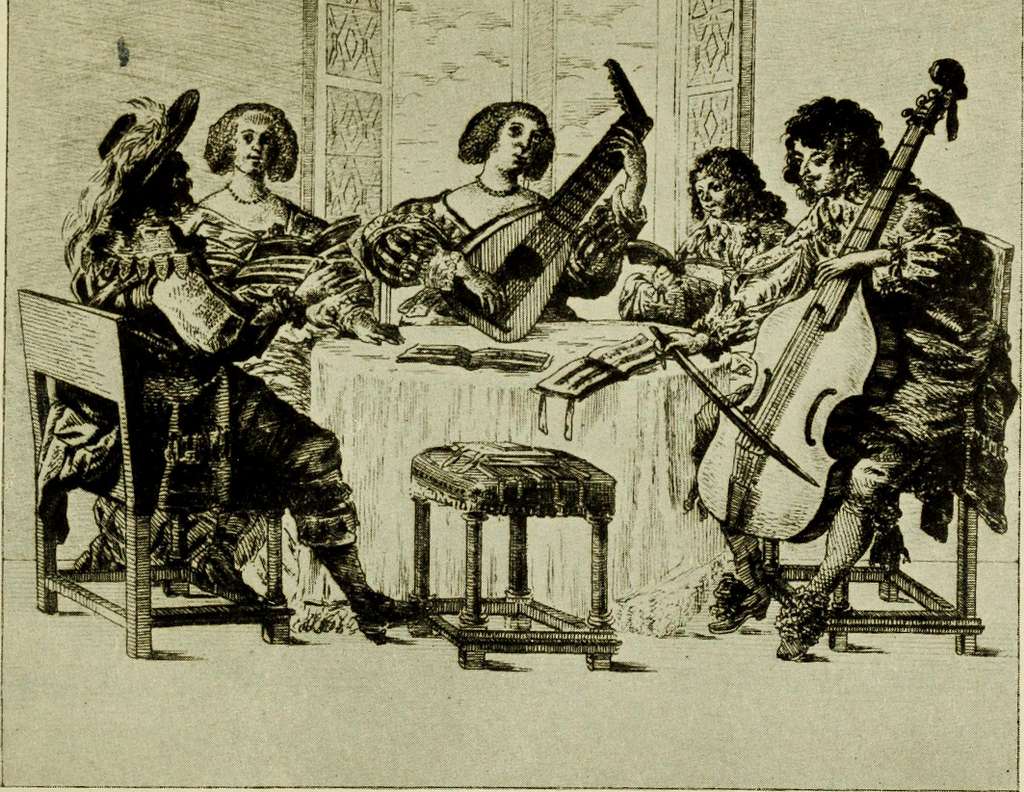
Everyone loves to make merry with bagpipes, fiddles, lutes and drums, so get your dancing shoes. Your throat should be well oiled for singing popular Christmas carols, like ‘O Come All Ye Faithful’ and ‘While Shepherds Watched Their Flocks By Night’. It also wouldn’t be Christmas without a trip to the theatre. Book early to get good seats. On the 28th December 1666, Samuel Pepys managed to see two plays: Macbeth at the Duke’s Theatre in Lincoln’s Inn Fields ‘a most excellent play for variety’ and Henry the Fifth ‘well done by the Duke’s people, … But I sat so high and far off, that I missed most of the words, and sat with a wind coming into my back and neck’. At least it was better than Twelfth Night, which he’d seen on Twelfth Night, 1662, and dismissed as ‘acted well, though it be but a silly play, and not related at all to the name or day.’
8. Be charitable
Keep an open house and a well stocked pantry as anyone might drop in. You can look forward to being invited over for a meal by your landlord and if you are a landlord, don’t forget to provide ample food and drink for your tenants. Christmas is the time for charity, so make sure you have spare change and food parcels for anyone who comes begging. On New Year’s day, exchange presents with your loved ones. Make up boxes for your servants, apprentices and tradesmen. Be generous and they’ll work hard for you over the coming year. The Secret Christmas makes for an especially nice gift at this time of year.
9. Party like it’s the Twelfth Night
It’s time to party (again). Don’t forget to hide a bean and a pea inside your Twelfth-night cake. The man who finds the bean in his slice of cake becomes King, or Lord of Misrule for the night, while the lady who finds the pea in her slice of cake becomes Queen. They will be obliged to cause maximum chaos, inverting all hierarchies and challenging all rules. Remember, it’s only temporary and an excellent way for everyone to let off steam.
‘Twelfth Night’
NOW, now the mirth comes
With the cake full of plums,
Where bean’s the king of the sport here;
Beside we must know,
The pea also
Must revel, as queen, in the court here.
Begin then to choose,
This night as ye use,
Who shall for the present delight here,
Be a king by the lot,
And who shall not
Be Twelfth-day queen for the night here.
– Robert Herrick
And so I bid you all a very merry Christmas. As the poet, John Taylor wrote, ‘Let’s dance and sing and make good cheer, since Christmas comes but once a year.’
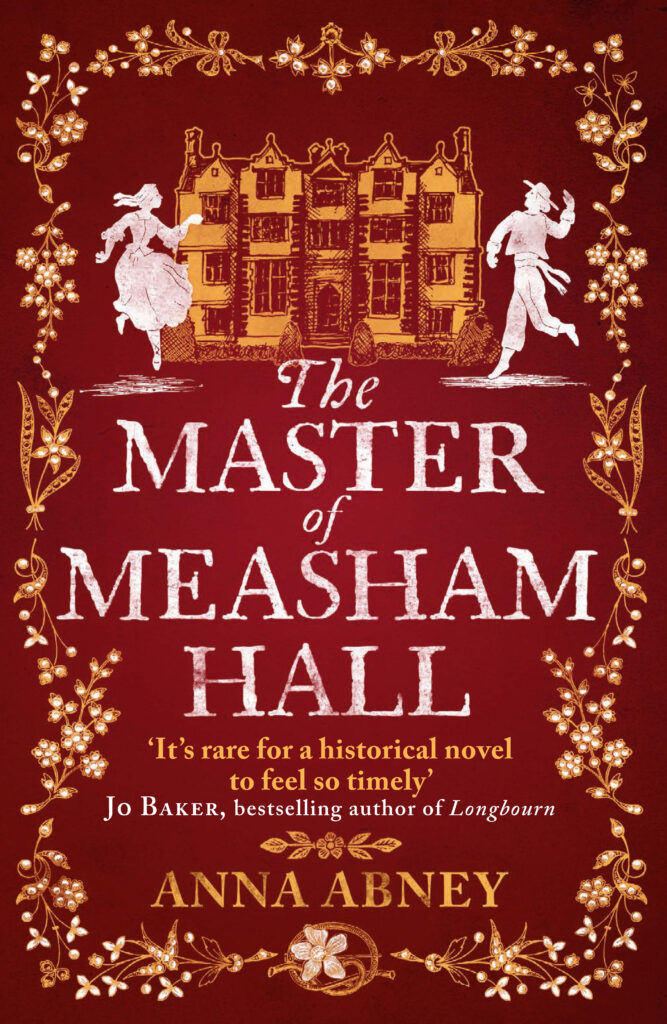
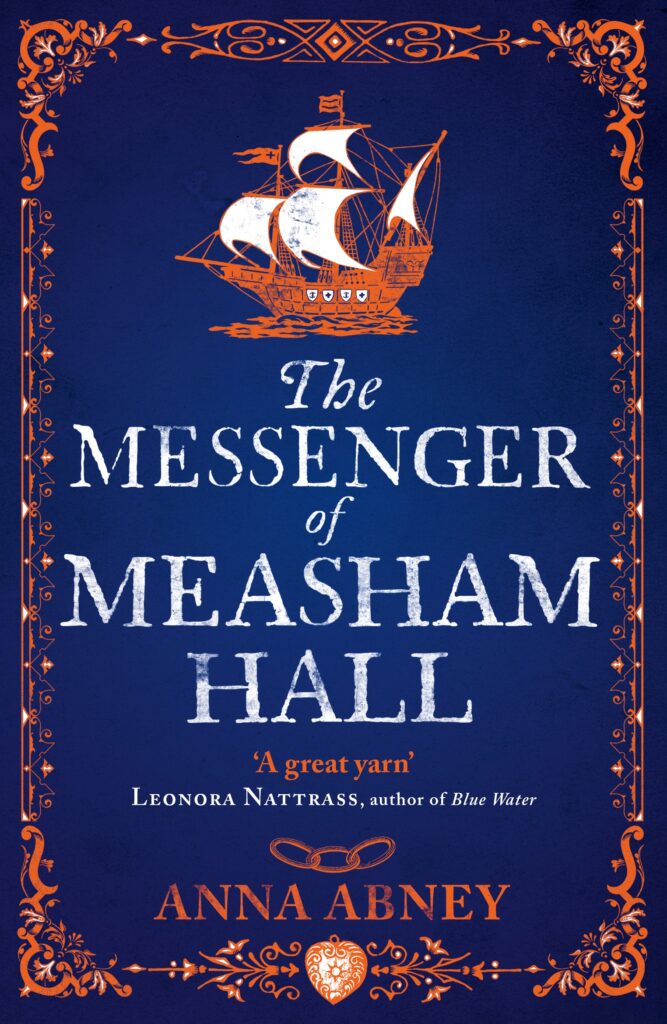
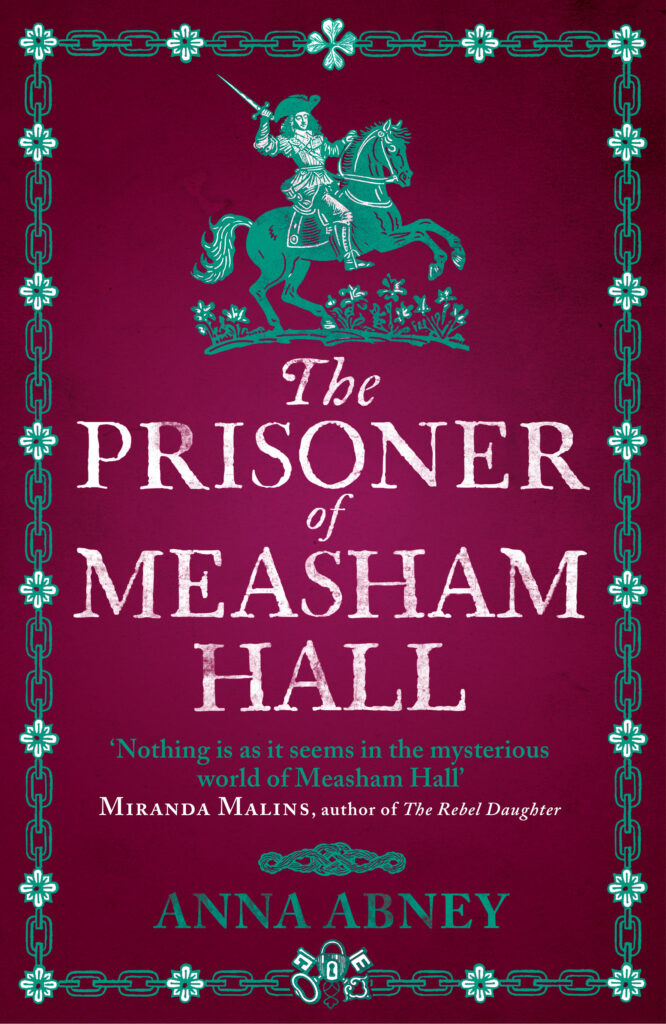
Anna Abney is the author of The Secret Christmas, a work of historical fiction that introduces readers to the Measham Hall trilogy. The series can be purchased from Duckworth Books by selecting the books below. Thank you for supporting independent publishing.
The exact date of Union Berlin’s formation is hard to say. In its current form, the club has only been around since 1966. But its roots go far deeper, stretching from the German Empire to the building of the Berlin Wall, via a revolution and two world wars.
Its earliest ancestor was SC Olympia Oberschöneweide (1906), before they moved to their current home in Köpenick as SC Union Oberschöneweide in 1920.
Did Union-know? When SC Union played Hamburger SV in the final of the German Championship in June 1923 the cost of a kilo of rye bread was in the hundreds of billions of marks.
After Germany was divided in the Cold War, the club split in two, with SC Union 06 in the West and the old club remaining at the Alte Försterei.
In 1951, the latter merged with a neighbouring club to form BSG Motor, dropping ‘Union’ from their name altogether and adopting the red-and-white which they still wear today.
When 1966 saw a drastic reform of East German football, the East Berlin club finally became the club we know today: 1. FC Union Berlin.
After Germany was divided in the Cold War, the club split in two, with SC Union 06 in the West and the old club remaining at the Alte Försterei. In 1951, the latter merged with a neighbouring club to form BSG Motor, dropping ‘Union’ from their name altogether and adopting the red-and-white which they still wear today.
When 1966 saw a drastic reform of East German football, the East Berlin club finally became the club we know today: 1. FC Union Berlin.
Köpenick, in the south-east of Berlin, is the home of Union Berlin. Only slightly to the north-west of Köpenick on the map, you can see Union’s ancestral home of Oberschöneweide.
2. Union Berlin and rivalries
The rivalry between Union Berlin and Hertha Berlin is notorious, especially following Union’s promotion to the Bundesliga in 2019. As of August 2023, Union have won the last five fixtures between the two clubs. Following relegation in the 2022/23 season, Hertha now play in the 2. Bundesliga.
The home kit colours of Union Berlin and Hertha Berlin.
However, Union’s traditional and fiercest rivals are Berliner FC (BFC) Dynamo. Though the two sides have not played a league game against each other since 2006, the once fierce rivalry is still a defining feature of Union’s identity.
In the Communist era, BFC were affiliated with Erich Mielke’s Stasi secret police. And the club’s advantages on the pitch were undeniable: they won ten titles in a row from 1979 to 1988 while Union suffered multiple relegations.
This inequality helped shape Union’s character as footballing outlaws in a world where the wrong people always won.
Things, however, have changed since the millennium. While Union began their march towards the Bundesliga, BFC have languished between the fourth and fifth tiers of German football.
To write or read Union like the English word ‘union’ is wrong, because that is not how Unioners themselves pronounce it.
The name is pronounced oon-yawn, rather than yoo-nyun. Grammatically, therefore, when you refer to a supporter it is ‘an Union fan’ rather than ‘a Union fan’.
4. Union Berlin fans built their own stadium
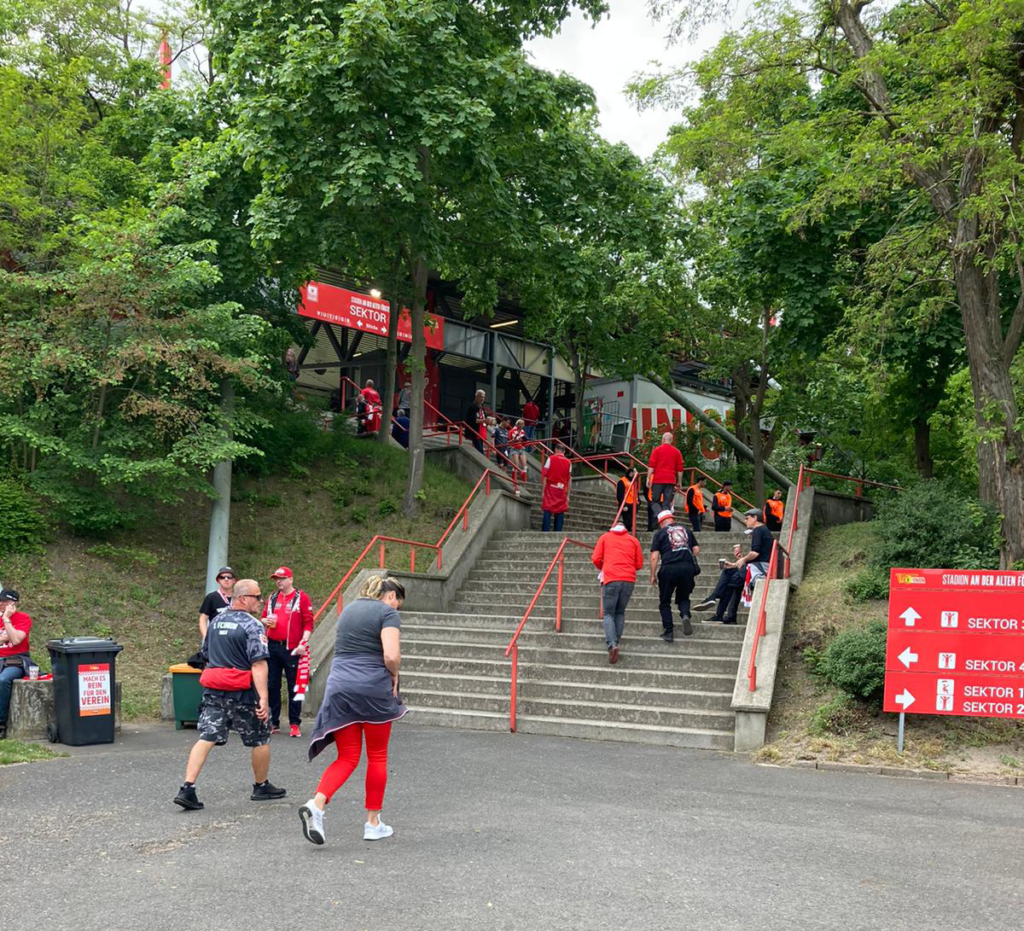
Union Berlin play their home games at Stadion an der Alten Försterei in Köpenick, which is in the south-east of Berlin.
Pitchside at the Stadion an der Alten Försterei
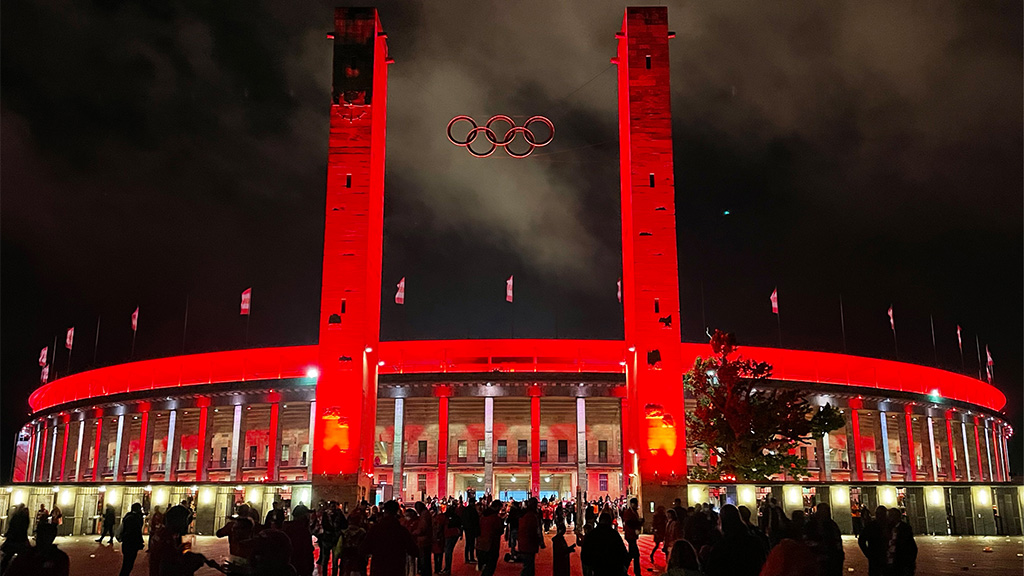
Union have played there for 102 years, after relocating from Oberschöneweide in 1920. The stadium is the oldest, most enduring element of the club’s identity: it’s older than the colours, the badge and the oldest supporters.
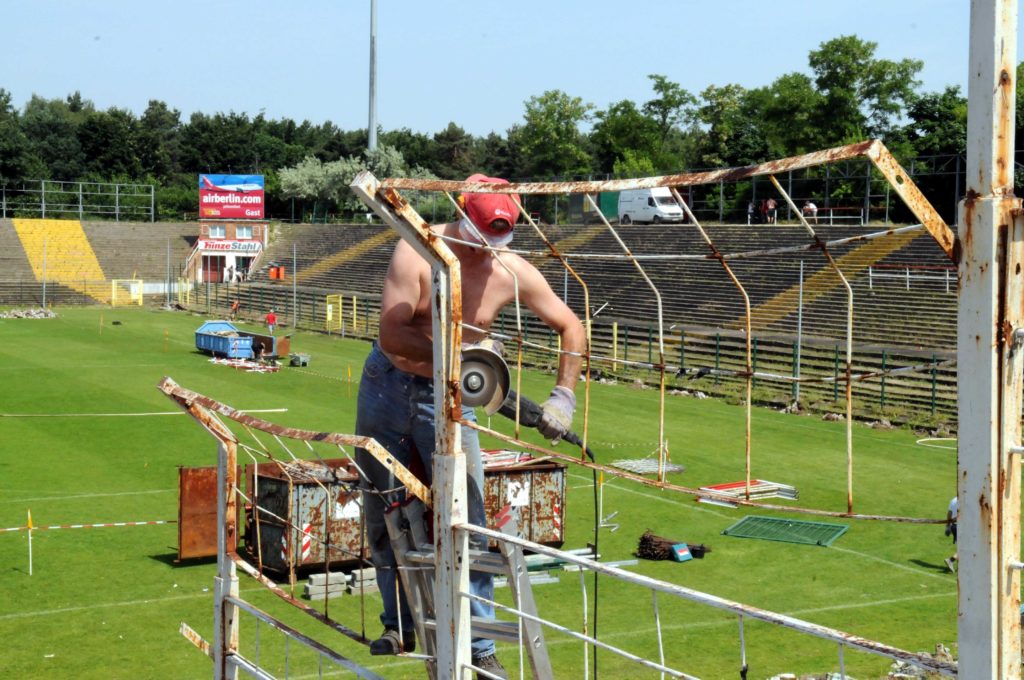
By the 1990s, the Alte Försterei was effectively unfit for purpose and plans were drawn for a rebuild. However, Union had very little money and only a handful of employees who were able to set up and run a fully functioning construction site.
So, during the 2008/09 season, 2,333 men and women – most of them volunteers – worked more than 140,000 hours to transform the Alte Försterei from a crumbling wreck into one of modern football’s most distinctive stadiums.
Did Union-know?
The fans’ efforts are now immortalised in a beer garden on the southern side of the stadium. In the shadow of the terraces stands a tall, stout column made of iron girders, which is decorated with metal plaques bearing the name of every single person
who signed up to help.
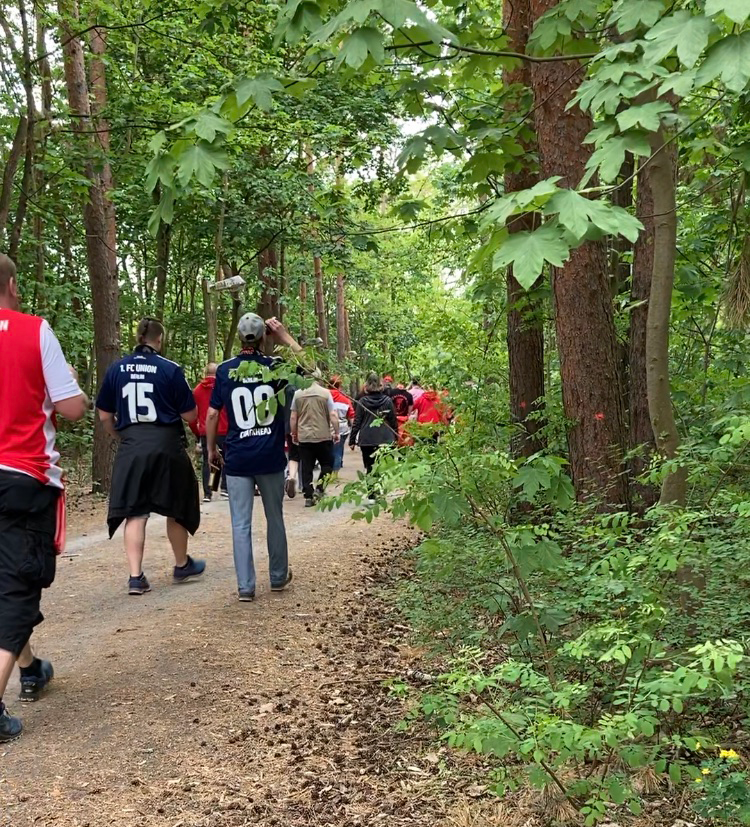
The Alte Försterei is on the urban edges of the forests and lakes which surround Berlin. To the north-west of the stadium is the Wuhlheide, a sprawling woodland park which stretches across the south-east of the city.
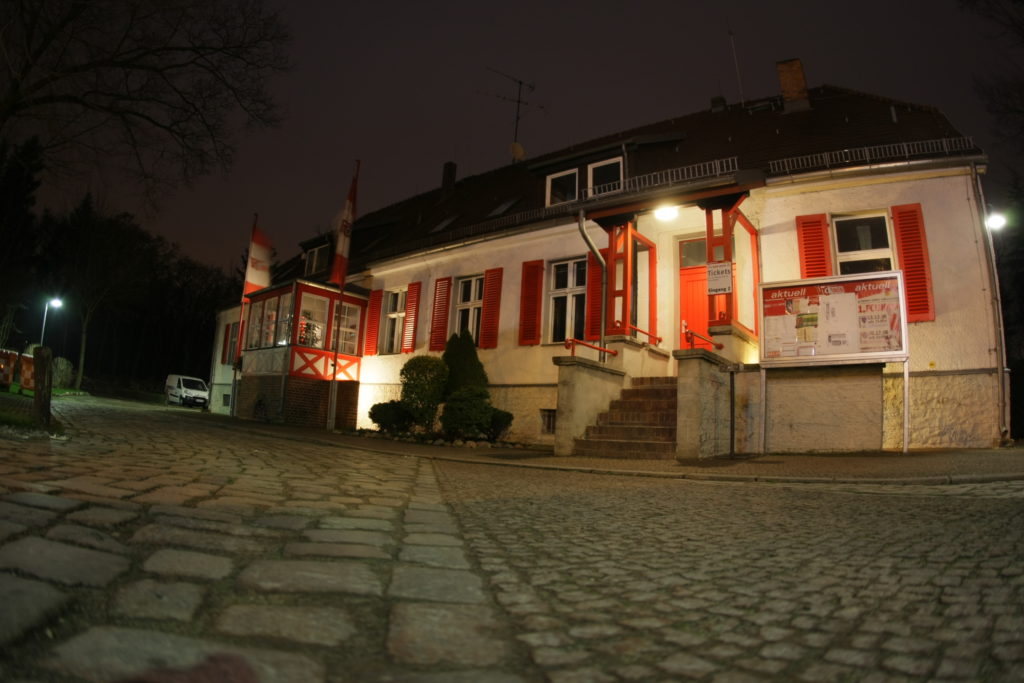
The club’s main offices are in the Old Forester’s House which gives the stadium its name.
Did Union-know?
When spectators were banished from stadiums during the pandemic, many Union fans simply climbed the trees to watch and cheer on their team from outside.
Union fans sing this song in tribute to their sylvan home:
“In uns’rem Stadion
In der Hauptstadt
In der wunderschönen, immergrünen Alten Försterei”
Translated to English, it reads:
“In our stadium
In the capital
In the beautiful, evergreen Alte Försterei”
In 2004, Union were so short of cash that they were on the brink of losing their league licence and being banished back into the wilderness of non-league football.
There followed a mammoth fundraising effort. At the centre of it was the Bleed for Union initiative, which allowed fans to donate blood in Union’s name. The ten euros compensation fee which was ordinarily paid to the blood donor themselves was wired directly to the football club.
7. Union Berlin's unique corner flags
Where most clubs just have their emblem or plain block colours on their corner flags, Union have a face. Designed by artist and Union supporter Andora, Der kleine Biss (‘The Little Bite’) flies from all four corners of the Alte Försterei. Literally.
According to Andora, it represents the bite Unioners have always had, ever since the beginning.
Did Union-know?
Union have qualified for Europe five times in their history. Three of them have come in the last three seasons.
Oddly, Union’s adventures in Europe have always been somewhat cursed.
When Union qualified for the European Cup Winners’ Cup in 1968, their dreams of travelling the continent were immediately dashed by an escalation of the Cold War. In the fallout from the Soviets’ brutal suppression of the Prague Spring, several Eastern Bloc countries, including East Germany, decided to boycott UEFA competition in the 1968/69 season.
Thirty-three years later, it was an international terrorist incident. In 2001, Union’s UEFA Cup first-round tie against Finnish side Haka Valkeakoski was originally scheduled for 13 September but was postponed after the 9/11 attacks in New York.
Two decades on, Union qualified for the 21/22 UEFA Conference League competition, challenging on the European stage for the first time in 20 years.
Cue the next international catastrophe. In the midst of the Covid pandemic, public health restrictions meant Union had to play their European home games in front of half-full stadiums. And to make matters worse, they couldn’t even play on the hallowed turf of the Alte Försterei. The stadium didn’t comply with UEFA regulations, meaning Union had to instead play at Hertha’s Olympiastadion.
Though Union had to continue playing their 2022/23 UEFA Europa League home ties at the national stadium, the campaign was crisis-free.
We wonder what their 2023/2024 UEFA Champions League adventure – Union Berlin’s first ever – has in store…
9. The World Cup Living Room
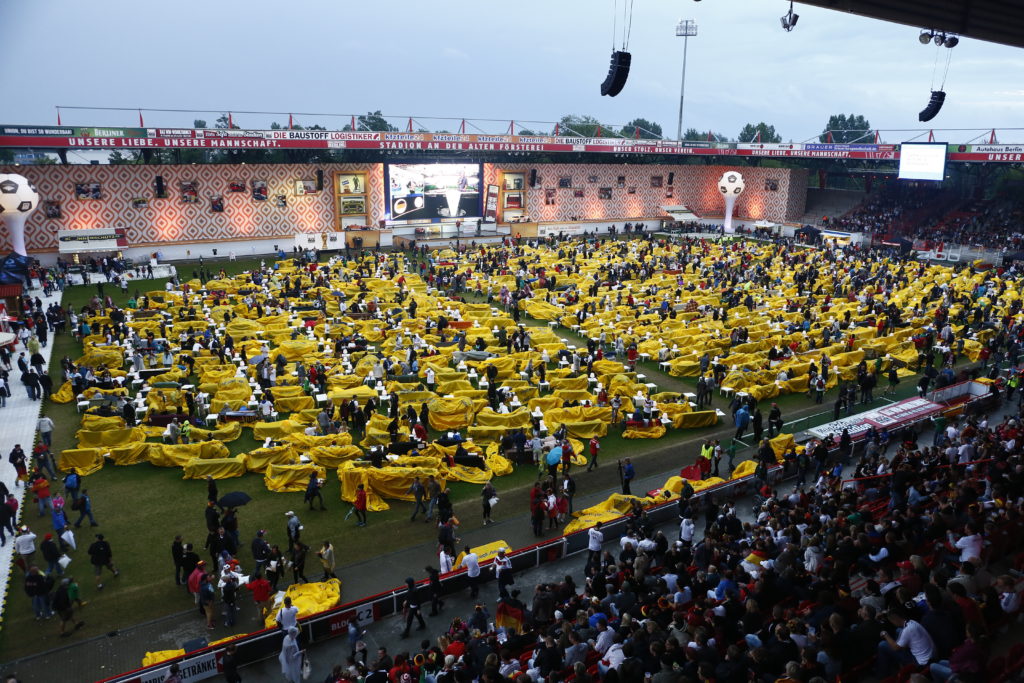
In 2014, the Alte Försterei was transformed into a ‘World Cup Living Room’, where fans could watch Germany games on the big screen. The stands were decorated with retro East German-style wallpaper, and the pitch was adorned with around 800 sofas which the spectators had brought from their own homes.
On the evening of 23 December 2003, a large group of Union fans snuck into the stands at the Alte Försterei and sang Christmas carols to banish away the blues felt by poor results in the league. The Union Christmas Carol Service – known as Weihnachtssingen – was born. Little did they know at the time that it would become a roaring success in years to come.
By the late 2010s, the so-called Weihnachtssingen had become a world-famous tradition, attracting hundreds of reporters and tourists from around the globe to the Alte Försterei every 23 December. With nearly 30,000 attendees every year, it is now one of the biggest Christmas events in the city.
No football club in the world has fans like 1. FC Union Berlin. The underdogs from East Berlin have stuck it to the Stasi, built their own stadium and even given blood to save their club. But now they face a new and terrifying prospect: success.
Scheisse! tells the human stories behind the unexpected rise of this unique football club. But it’s about more than just football. It’s about the city Union call home. As the club fight to maintain their rebel spirit among the modern football elite, their trajectory mirrors that of contemporary Berlin itself: from divided Cold War battleground to European capital of cool.
'A wonderful journey into the heart of a unique club'
Raphael Honigstein
Author of Das Reboot and Klopp: Bring the Noise
'An engrossing portrait of a football club that carries with it the story of Berlin with all its appealing contradictions: a city with a radical counterculture guarded with conservative zeal, a global metropolis with a village mentality, a cultural niche that becomes cooler the harder it tries not to be'
Philip Oltermann
Journalist and author of Keeping Up With the Germans and The Stasi Poetry Circle
'The history and culture of a special football club deserve a special kind of chronicling – and Holden has executed it to perfection'
Patrick Barclay
Award winning sportswriter and author of Football – Bloody Hell!
'Holden delivers a beautifully crafted set of stories that reveal a personal history of one of Germany’s most special clubs and cities'
Jonathan Harding
Author of Mensch and Soul
'A fascinating tale that is expertly told. By focusing on the figures behind the scenes, Kit Holden captures the social and cultural history of Union and in doing so does this special club justice'
Adam Bate
Sky Sports
'For the first time, "Scheisse" is a good thing! A captivating read on one of the most unique clubs in world football'
Archie Rhind-Tutt
Bundesliga touchline reporter for ESPN
'Kit Holden superbly portrays the fascinating and inspiring football club that is “Iron Union”. He captures the myth, the history and the spirit that make Union so very special and beloved'
Andreas Michaelis
State Secretary, former Ambassador to the UK and long-time Unioner
'A must-read for any football romantic, regardless of where you're from and what team you support'
‘This was as much a social and political history of Berlin as a football book. Like many other fans I have been taken by surprise and fascinated by the recent rise of Union Berlin and this well written and researched book by Kit Holden digs well beneath the surface and puts their achievements fully into context. Peppered with fan anecdotes this is a rollicking and enjoyable read. Highly recommended’ Greville Waterman, NetGalley
Rated 5 out of 5
‘What a brilliant book! This is a detailed, thoughtful and intelligent chronicle of the rise and fall… and rise and fall… and rise and rise of a football club which has a real identity as an integral part of the tough East Berlin community in which it is situated. The format of the book, telling the story of Union Berlin’s history and evolution through the perspectives of those people most closely involved brings realism and a real sense of what the club means to those people… I highly recommend this book to football fans and any non-football fans interested in a true “David and Goliath” tale told against the backdrop of a fascinating period of post-war European history’ Tony McMullin, NetGalley
Rated 5 out of 5
‘Holden tells the history of the club and the city through interviews with a variety of fans and officials. It’s an inspired choice and the narrative weaves excellently between personal recollections and the over-arching story of both the city and the club’s past, present and future. The book is packed with stories and recollections of fans and their passion oozes out of every page. It wonderfully captures the essence of the club and what makes it special… Scheisse! is an absolutely brilliant book. It captures the very essence of why sport matters’ Brendan Crowley, All Sports Book Reviews
Rated 5 out of 5
‘An outstandingly fun read, this will make any reader a fan of Union… I can definitely see me egging them on in the majority of their games next season, and more relevantly, egging this book about them on to the heights it deserves to achieve’ John Lloyd, NetGalley
Rated 5 out of 5
‘Union Berlin are one of the most fascinating football clubs in Europe. Their story and their remarkable success on the pitch of the last few years is told really well by Kit Holden. In each chapter a supporter is interviewed about a particular milestone that has shaped this unique club. It is also a history of the changing city of Berlin from the cold war to today. I loved it’ Jim Hanks, NetGalley
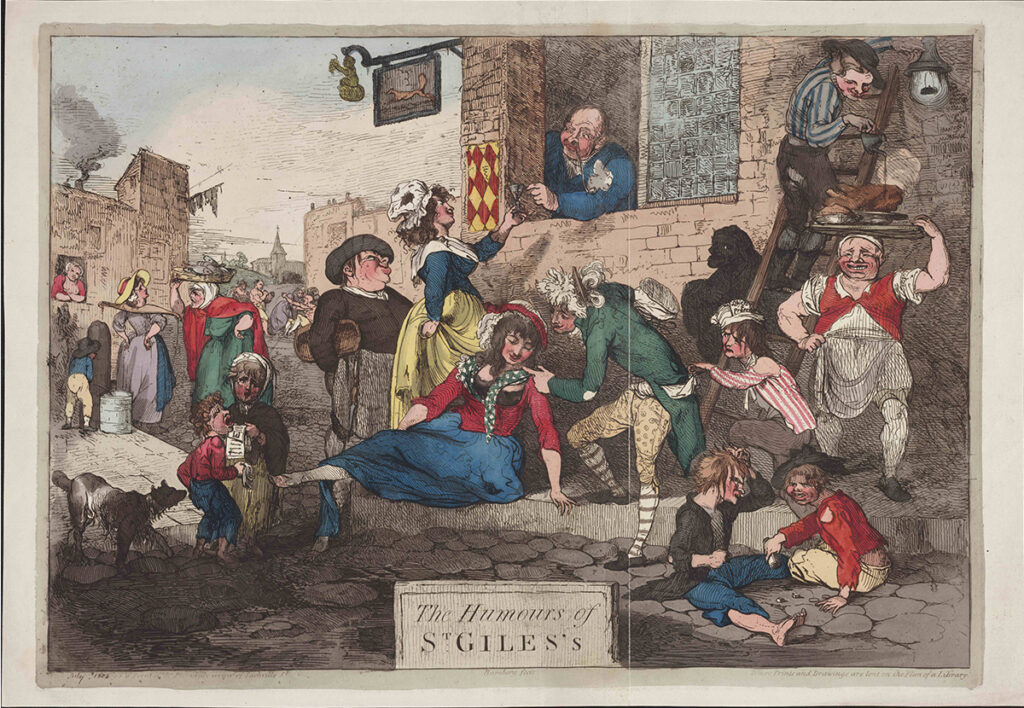
Not of the bun-selling boy on the cover; he came last of all and his gaze will fascinate me forever. But with a very different sort of image – a bright, chaotic, Regency caricature, not the first thing you’d associate with the lived reality of the nineteenth-century street.
The Humours of St. Giles's
The picture in question (Figure 1) is The Humours of St. Giles’s, first published as an engraved print in 1788, and in this coloured edition (below) in 1803, but originally drawn by a man called Johann Heinrich Ramberg.
Figure 1: The Humours of St Giles's
Ramberg, a young Hanoverian, was a court painter to George III. By birth and by station, he was a stranger twice over to the world he sends up here in riotous Hogarthian style.
Admittedly, the people responsible for turning his image into a print were a little lower on the social ladder. Thomas Harmer and Samuel William Fores, its first and second publishers, were technically mere tradesmen.
But even their gleaming shopfronts opened on to high-class Piccadilly, a world away from the grubby slum that Ramberg has depicted.
This is why I wanted to write a book about the real people behind pictures like Ramberg’s.
I’ve written Vagabonds almost in opposition to that picture, in a mixed spirit of empathy, frustration, fascination, determined to get past these snooty representations to a world of first-hand experience.
I’ve written Vagabonds almost in opposition to that picture
But perhaps the best way to begin isn’t by throwing The Humours of St. Giles’s aside. Partly because it’s not the sort of thing people did throw aside.
Roughly A3 in size, it was worthy of being pasted on a wall or into an album, and would set you back, for the coloured edition, full two shillings – about two days’ earnings for the street-sellers it mocks.
If we want to empathise with those sellers, we can’t afford to start throwing things away. So instead let’s keep it and look at it once more.
The most obvious question to ask of this picture – where are we? – has an equally obvious answer: we are in Ramberg’s imagination.
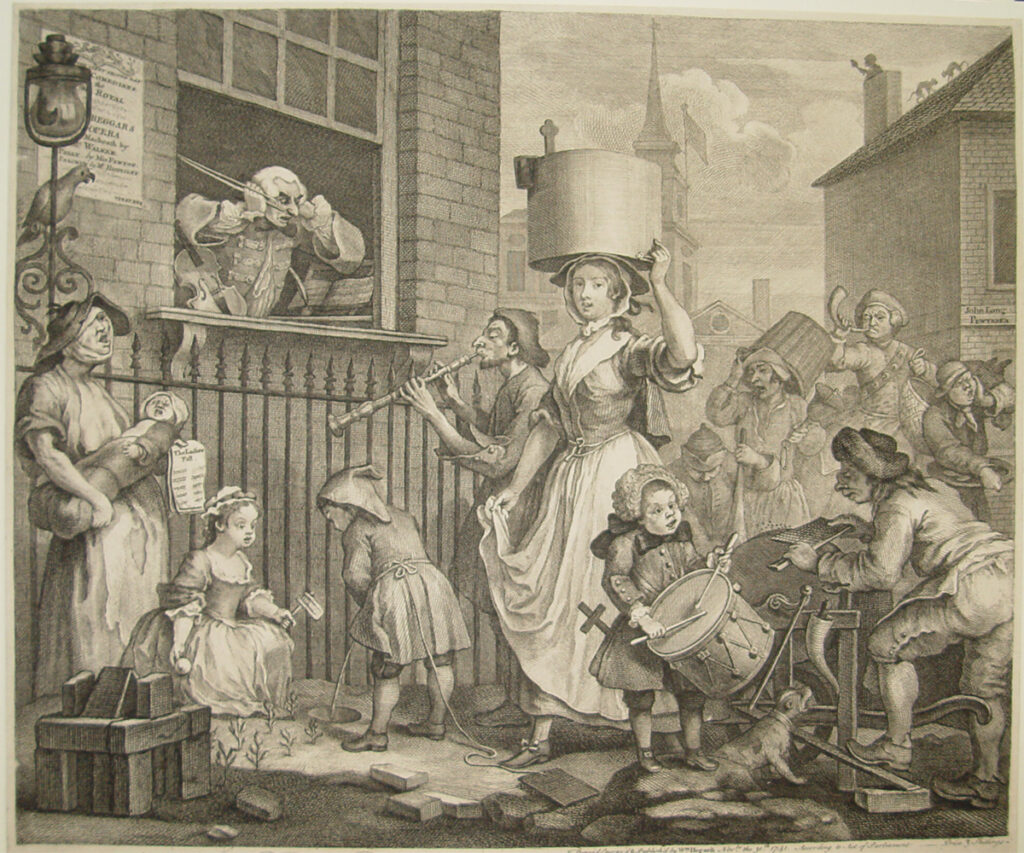
He has conjured into being a cast of street people taken from life, from stereotype, from other pictures: the boy piddling into the milkmaid’s pail is an irreverent updating of two figures from William Hogarth’s The Enraged Musician. (Figure 3)
Figure 3: The Enraged Musician
Ramberg has arranged them in a made-up street. But it looks like Seven Dials, the geographical and spiritual heart of St Giles’s.
The pub sign might be the Fox, on Castle Street. The church in the background is surely St Giles in the Fields, but Ramberg has taken the ‘fields’ bit rather literally, gesturing towards what remained true at the end of the 1780s – central London was still open to the country, and there really were rolling fields just the other side of the British Museum.
You could traipse them all the way to Somers Town and suburban St Pancras, if you were prepared to trespass and weren’t afraid of cows. We’re in the centre of London’s first slum, but the growing green world is just over there.
We’re in the centre of London’s first slum
It’s plain enough what Ramberg is up to: moral lessons with a wink.
Here are lust and gluttony front and centre, sloth in one corner, wrath and pride in the background. Satire and disorder rule.
The lamplighter’s oil pollutes the cook’s steaming joint just as the boy’s urine pollutes the unattended milk. A pickpocket sports a pamphlet in his cap that proclaims ‘Liberty & Property’. The watching chimney-sweep wears his own shadow.
These are also sins being punished: it’s the bickering milk-maid, the lazy butcher, the lecherous hairdresser, the old man who fancies himself still a bare-knuckle boxer, who get their come-uppance. So there is a moral order in evidence after all, albeit an unforgiving one.
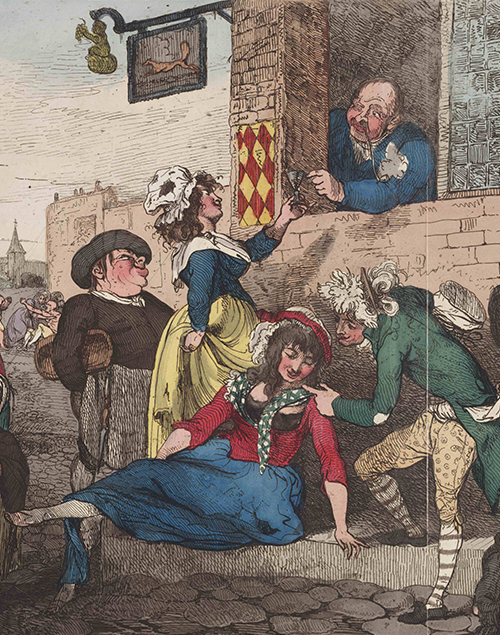
Figure 4: The publican serves a young Irishwoman a measure of gin
Nowhere is this clearer than in the strong diagonal sweep that gives the picture its shape.
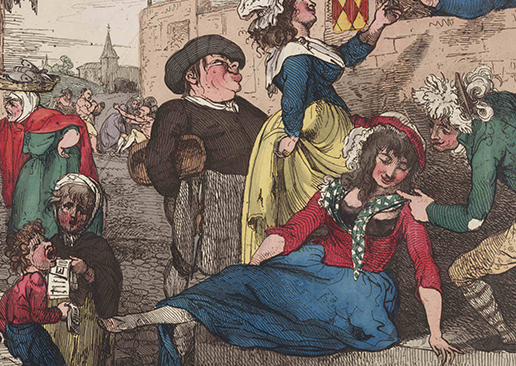
The publican serves a young Irishwoman a measure of gin (see Figure 4). From the leer on the face of the baker at her side, we begin to suspect this might be going somewhere.
It is, says Ramberg, and leads our eye to the quite literally fallen woman, drunk and vulnerable, preyed upon by the lecherous hairdresser.
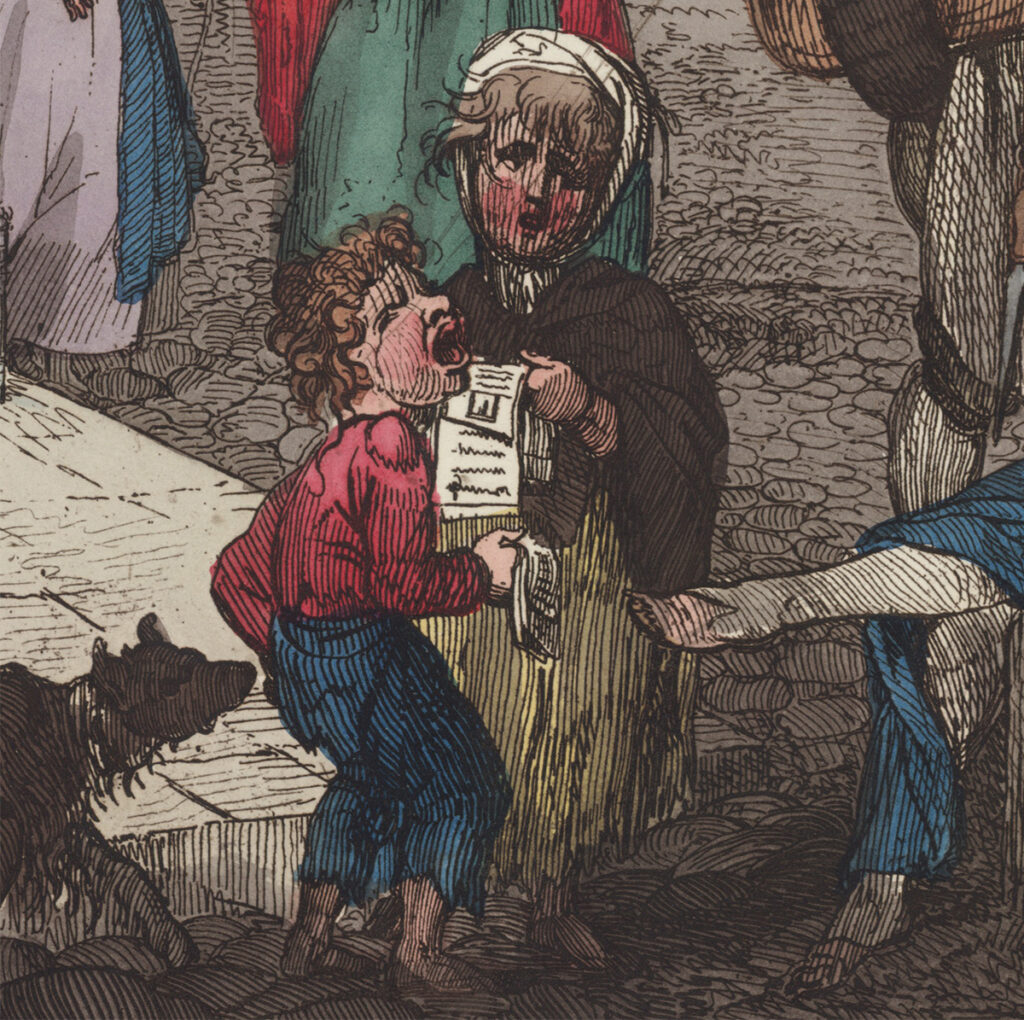
In the original engraving, her breasts are bare – and so are her feet, which point us to the fruits of all this dissolution: two ragged children in the gutter, reduced to ballad-singing in order to survive (Figure 5). The boy, perhaps flea-ridden, scratches his behind as a dog approaches to sniff it – they are, suggests Ramberg, no better than beasts.
Reduced to ballad-singing in order to survive
Here are lust and gluttony front and centre, sloth in one corner, wrath and pride in the background. Satire and disorder rule.
But he has something even worse in his mind. Look closer still, and you can just make out the woodcut illustration on the slip-song that the girl – the young singer we started with – is carrying.
Figure 5: Two ragged children in the gutter, reduced to ballad-singing in order to survive, The Humours of St. Giles's
It’s someone being hanged.
For painter, printer, purchaser, it all confirms the received wisdom: this is the underclass, condemned through their own wickedness to the gutter or the gallows. A morbid moral for a ‘humorous’ picture. And a terrible attitude to take towards some of a city’s most interesting and energetic citizens.
For the first time, this innovative social history brilliantly – and radically – shows us the city’s most compelling period (1780–1870) at street level.
From beggars and thieves to musicians and missionaries, porters and hawkers to sex workers and street criers, Jensen unites a breadth of original research and first-hand accounts to tell their stories in their own words.
What emerges is a buzzing, cosmopolitan world of the working classes, diverse in gender, ethnicity, origin, ability and occupation – a world that challenges and fascinates us still.
‘Jensen gives these past lives a monument, a dignity and recognition they deserve. For a brief moment, in the pages of this extraordinary book, they are London and London is them’ Gerard DeGroot, The Times
‘A vigorous and necessary account made timely by the widening chasm between obscene wealth and dire poverty in our contemporary metropolis’ Iain Sinclair, author of The Last London
‘Vagabonds allows readers to feel the injustices and the seeming inevitability of lives going wrong. The writing is compelling, often displaying the flair of a nineteenth-century journalist or courtroom lawyer’ Ana Alicia Garza, TLS
‘Compellingly written, utterly captivating… Jensen’s book is stuffed to bursting with original voices and sources alongside his well-crafted expert analysis… every page of Vagabonds rings with the thrum and bass of a city that saw itself as the centre of the world’ Fern Riddell, BBC History
‘Rich in research… a telling account’ Martin Chilton, Independent
The story of In Ordinary Time is not a linear one. I write about the deaths of my siblings, alcoholism, family mental illness, the Famine, British colonialism in Ireland, the abuses of the Catholic Church and the Irish State. I wanted to show how these traumas manifest in individual lives in the present.
There are three strands in this memoir:
1. the story of my life (1973-present),
2. the history of Ireland,
3. and the pre-historic and mythological stories that have filtered through.
Our understanding of time is fundamental to our understanding of ourselves, and I found Henri Bergson’s concept of la durée to compliment the Celtic wheel of the year.
Here are some of the concepts and characters – the Celtic Calendar and Irish saints, gods and goddesses – that helped bring this story around.
Imbolc
The pre-Celtic feast of Imbolc is celebrated from sundown on February 1 to sundown on February 2 (to include a full rotation of night and day). Imbolc means “in the belly” in recognition, perhaps, of pregnancy in ewes.
February 1 is the first day of Irish Spring.
First day of Spring
The Goddess, Brigid
Brigid is the goddess of Imbolc. She is patron of the healing, smith-work and poetic inspiration. A protective mother goddess, she ushers in spring with its all its possibilities, renewals and new life.
St. Brigid
In Ordinary Time begins at St. Brigid’s Church in Manhattan’s East Village. A young Irish woman died an alcoholic death in a church portal on a cold February night in 2011.
An investigation into her life brought me into a confrontation with my own, and with the larger social structures that shaped us both.
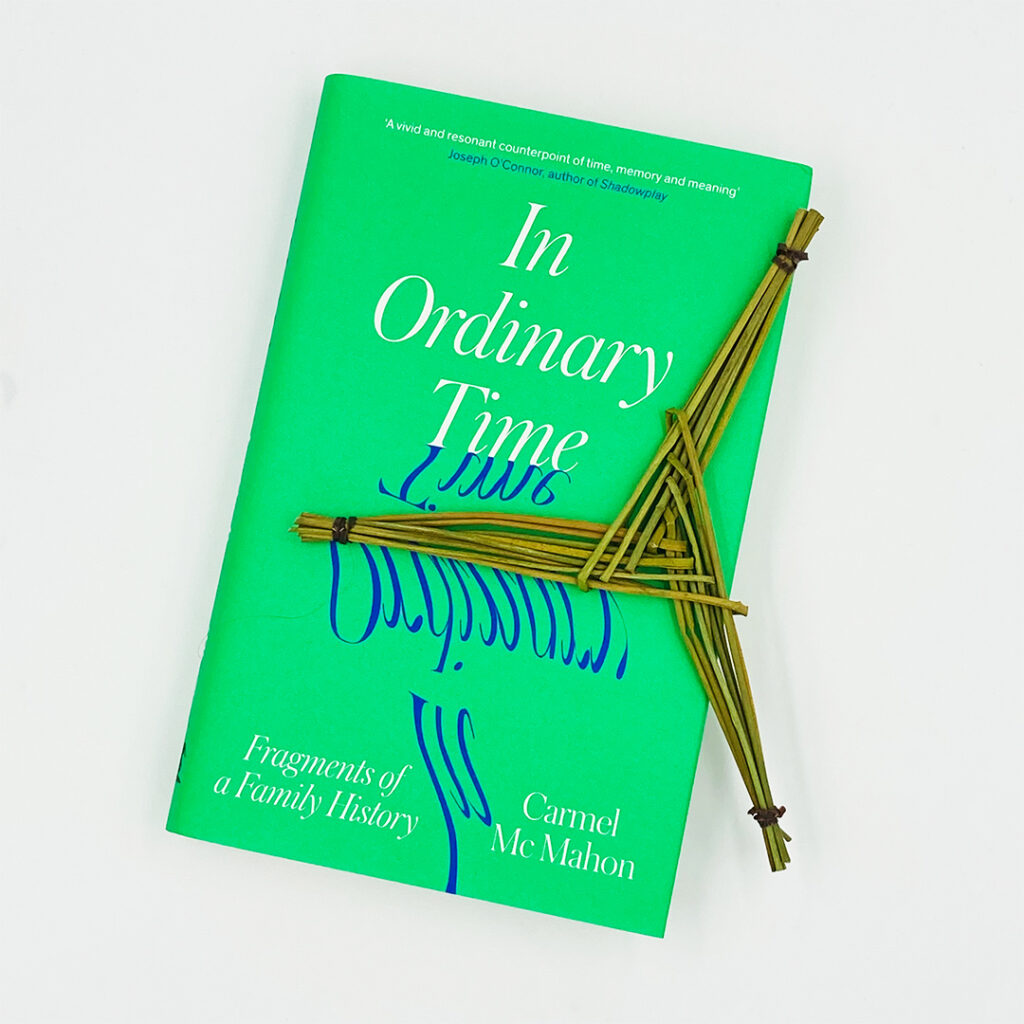
In Ordinary Time with Brigid's cross, handmade by the author, Carmel Mc Mahon
As a child, St. Brigid (451 – 525CE) was fostered out to a Druid to be educated. Later, she converted to Christianity and became a nun. She started Ireland’s first Convent and art school. Writing about her in the middle ages, Christian monks superimposed stories of her life over those of the Goddess Brigid. These were used as teaching tools to convert a deeply pagan people.
However, St. Brigid retains much of the pre-Christian spirit, and Irish people, particularly women, carried her stories with them when they emigrated around the world.
St. Brigid’s Feast Day coincides with Imbolc. It can be celebrated on February 1st or 2nd.
1 February 2023 will be the first state recognized St. Brigid’s Day, and the first Irish holiday named for a woman. The publication of In Ordinary Time on 2 February will coincide with this celebration.
St. Patrick
St. Patrick is Ireland’s patron saint. He is recognized for bringing Christianity to Ireland.
His feast day is March 17 which coincides, approximately, with the spring equinox, which falls half way between Imbolc and Bealtaine.
A stained glass window featuring St. Patrick
When I was growing up in Ireland in the 1970s and 80s, approximately 90 percent of Catholics attended Sunday Mass on a regular basis. St. Patrick’s Day was a holy day of obligation.
The name Patrick is of Latin origin, Patricius meaning “father” or “nobleman.” The patriarchal name helped me understand the hold the Catholic Church had over the forming psyches of generations of Irish people.
Bealtaine
Bealtaine is celebrated on May 1. It is the first day of Irish summer, a time for youth, fertility and finding love.
I identify this time with emigrating, a young working-class woman leaving an oppressive Ireland for the freedom and adventure of life in New York. It is a time of new friendships, of falling in love and trying to find a creative voice. It was during this period of partying that my adventures in alcoholism commenced.
The summer solstice occurs during the season of Bealtaine
The summer solstice occurs during the season of Bealtaine. “Solstice” means “sun stands still.” On this day, June 21, it appears the sun stalls momentarily in the sky, before pitching us toward the darkening half of the year.
My brother died in a motorcycle accident on the summer solstice in 1998. This event felt like a rupture in time. The world before, and the world after Peter died.
Lughnasadh
Lughnasadh is a harvest feast. It is celebrated on August 1st, the beginning of Irish Autumn.
It falls mid-way between the Summer Solstice and the Autumn equinox.
A modern Lughnasadh corn dolly representing the god Lugh
The God, Lugh
Lugh (for whom Lughnasadh is named) is a harvest God. His name evokes a promise, that what was sown will be reaped.
I think of the fragments of my family history from Famine times to the present, our struggles with alcohol through the generations, and how all the buried, forgotten and dismissed parts of ourselves find a way to surface.
The Autumn Equinox
The autumnal equinox falls mid-way between Lughnasadh and Samhain. It marks the day when daylight and night are of equal length.
It was during this time that the story of coming to sobriety found a way to be told.
Loughcrew Cair, Co. Meath at Autumn Equinox
Samhain
The feast of Samhain is celebrated on the eve of October 31 to the eve of November 1.
It has evolved into Halloween, but it was once Celtic New Year. The Celts celebrated the start of the day at dusk and the start of the year going into the dark months. They understood that darkness is as necessary as light for harmony and growth.
Neopagans in Ireland celebrating Samhain
On the eve of Samhain, the veil between this world and the Celtic Other World, inhabited by the departed and other beings, is so close that it is possible for us to cross back and forth.
It is a time to reconnect with our ancestors, and to remember that our beloved dead are always beside us.
In this dark time of the year, I thought about the dark moments in history, like when, in the mid-nineteenth century, Irish immigrant women were used for medical experimentation in New York hospitals.
In the present, there was the dark period of my brother’s mental health crisis, and my own ongoing struggle to accept the cloud of chronic migraine that blots out days of my life every month.
The Winter Solstice
The Winter Solstice occurs around December 21. It was a vital celebration for the agrarian, ancient peoples of Ireland.
Monuments like the five-thousand-year-old Newgrange celebrate this time.
It marks the turn from darkness to light, and those first few rays of morning sun that will continue to rise earlier and earlier in the coming months.
Carmel Mc Mahon at Newgrange monument, Co. Meath
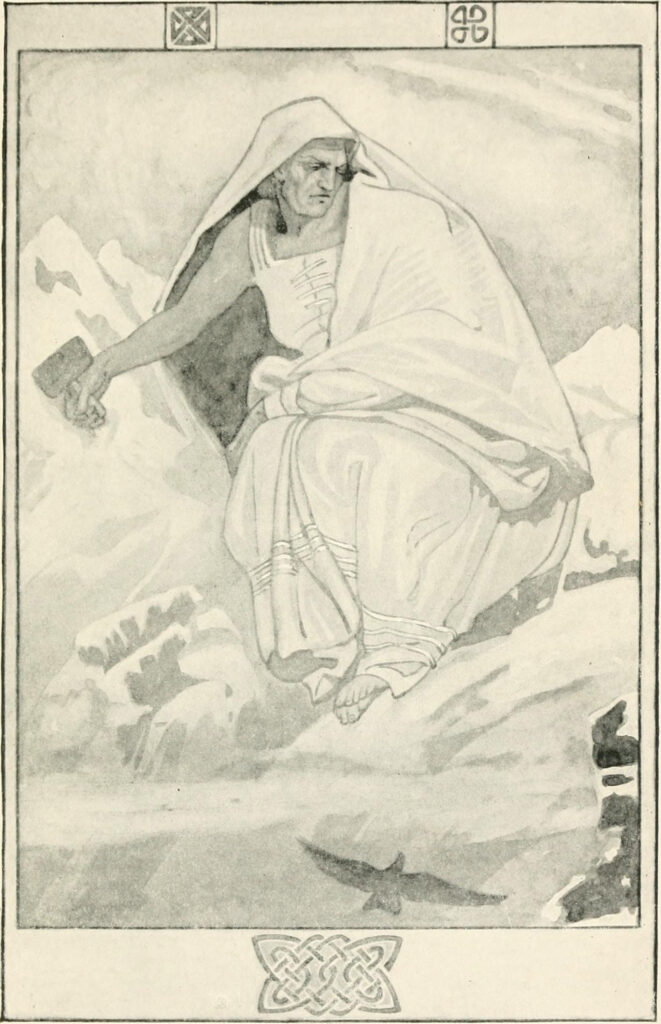
The Cailleach
It was in the darkness that I encountered the Cailleach, the wise old woman of winter.
She is a creator goddess and it was in her time that I moved home to Ireland, to the rugged landscape she carved out of Ireland’s West coast.
She helped me to understand the cyclical rather than the linear nature of time.
Illustration of the Cailleach by John Duncan in Wonder Tales from Scottish Myth and Legend (1917)
She tries to prolong winter as long as she can, but there comes a morning where she just stays in bed, and as she drifts back into sleep, she lets go, little by little, and when she does, the ground softens, Brigid returns, and another new season begins.
Mc Mahon’s powerful memoir is a multi-layered exploration of trauma, time, memory, grief and addiction that draws connections to the events and rhythms of Ireland’s long Celtic, early Christian and Catholic history.
Memoir
Hardback
£16.99
256 pages
ISBN 9780715654477
In 1993, aged twenty, Carmel Mc Mahon left Ireland for New York, carrying $500, two suitcases and a ton of unseen baggage. It took years, and a bitter struggle with alcohol addiction, to unpick the intricate traumas of her past and present.
From tragically lost siblings to the broader social scars of the Famine and the Magdalene Laundries, In Ordinary Time mines the ways that trauma reverberates through time and through individual lives, drawing connections to the events and rhythms of Ireland’s long history.
‘A vivid, evocative and resonant counterpoint of time, memory and meaning’ Joseph O’Connor, award-winning author of Shadowyplay
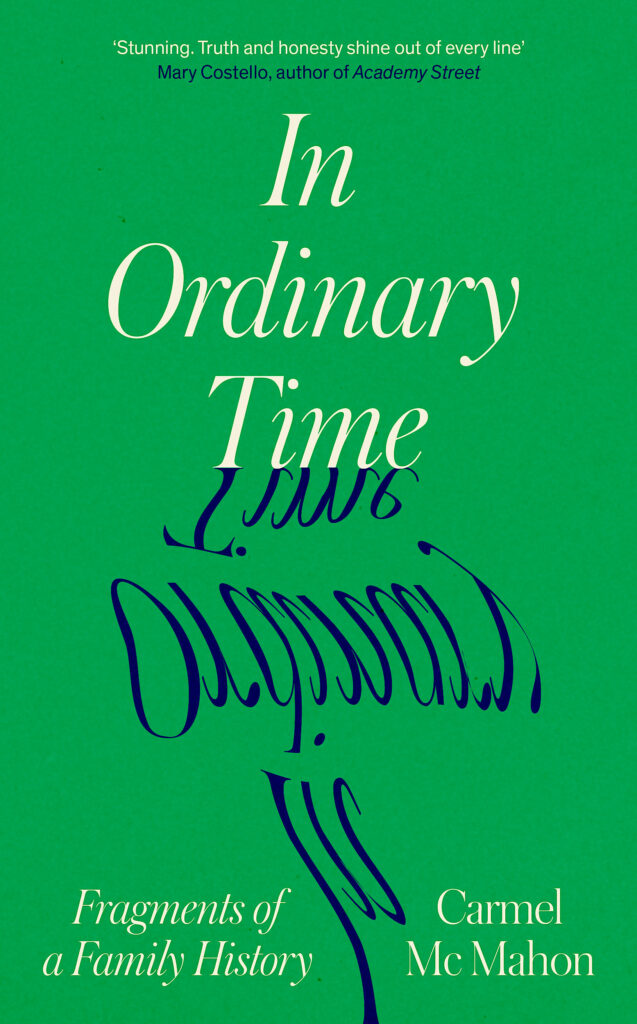
‘Stunning. A work of great emotional and intellectual heft, about how familial trauma and the collective past suffering of a nation can engender the nameless psychic pain of the individual. Truth and honesty shine out of every line’ Mary Costello, author of Academy Street
‘Beautiful, compelling, thought-provoking… Mc Mahon draws us a kind of map for our broken hearts… An uncompromising reflection on what it means to be of Irish heritage today’ Tara Flynn, author, actor and broadcaster
‘In Ordinary Time is painfully familiar in its account of family loss and trauma in the urban working class… Sensitively written and quietly devastating, it’s the book I had been waiting for — the darker shadow twin of Marian Keyes’ Niamh Campbell, award-winning author of This Happy
‘Magnificent. In Ordinary Time is a brilliant combination of the personal and impersonal, of the collapsing of the two worlds one into the other. Spare, pristine, bracing – a marvellous book’ Carlo Gébler, author of Confessions of a Catastrophist
Duckworth Publishing Assistant Hodan Ibrahim provides some useful advice to publishing hopefuls looking to enter the industry.
Hello to the publishing world and people who aspire to enter. I’m Hodan and I’m writing about my experience of working in an indie publishing house!
I was inspired to write this blog entry because there are many stories of people giving up on their dreams because breaking into the industry is challenging and competitive. We are all book lovers fighting for the right to be here.
Knowing where to look for a role and getting advice on starting your search can be daunting! It’s understandable because my first questions and Googles out of university were ‘is publishing a hard industry to break into?’ and ‘what skills do I need to get into publishing?’ This led to an endless cycle of searches that did not give me clear answers.
Luckily, I found a role as a Sales and Publicity Assistant at Duckworth by applying on my council job board. My role is part of the government work scheme, Kickstarter, that gives young people ages 18-25 six months of work experience.
My time at Duckworth taught me much about what is needed for a person to work in publishing beyond a love of books. (Although loving books makes work more fun!)
I hope the following advice will help you to make the most of your experience and give publishing hopefuls an insight into what you should look for.
Explore working for a small publishing house
Don’t only set your sites on the Big Four publishing houses and their imprints. See if your local area has a publishing house; you will be surprised with whom you find.
When I started looking for a role in publishing, I knew about the Big Four, the powerhouses of the industry. When it came to looking for a position within publishing, I was only looking on their job boards. I didn’t realise I was limiting myself as there are so many other places to work, including indie publishing houses or magazines and a thousand other creative forms of publishing.
Duckworth Books wasn’t on my radar, but it should have been – it’s a legacy publishing house. With its 125-year anniversary next year, it has stood firm as an independent for so long!
Working in a small team is fantastic. I was able to contribute many ideas that influenced decisions, which I doubt would have been the case if I was working in a big publishing house. It was so helpful in building my professional confidence.
It can be hard to deal with the enormous amount of media and blogger mail-outs that I had to send (I am best friends with the postman at this point), but it was always within a relaxed, supportive atmosphere which has been amazing whilst learning the ins and outs.
In a small publishing house, I felt that my growth and development were considered and seen as significant. My manager, Matt (Head of Sales, Publicity and Marketing), has been great, especially in answering my many questions. I asked so many questions… Matt should be knighted!
Prepare goals of what you want to learn
When starting the role, I wrote out three goals I wanted to achieve. They were small, but they helped me to focus on what I wanted to do each week. I also did this because I wanted a documented trail of my achievements.
MY PERSONAL GOALS
Share an idea or speak my opinion in a meeting
I struggle to voice my opinion in professional situations. Or I accidentally blurt out an idea without explaining it because I panic and word vomit. Having this goal has allowed me to think and plan my thoughts. As the weeks went on, thoughtfully sharing my ideas became second nature.
Learn something new each week
It could be a word, a process, an idea, or a discussion that I found interesting. I set this goal because I usually forget the nugget of information I hear while working and then get frustrated because I didn’t investigate that interest. An example is the fun I had looking into how books are turned into braille. I asked the owner, Pete, and he was terrific, giving me a detailed explanation. Afterwards, I watched videos and read more about the subject.
Ask for help when I need it and tell others if I’m lost/confused
As a person with learning difficulties (ADHD and dyslexia), I am very good at making mistakes and then taking them personally. But in this role, I informed my team about my limitations because I have learned that people can’t help or see you struggle if you don’t tell them. This means I can go to work and be honest with the team when I get lost or overwhelmed by a task, allowing them to help me and continue developing.
Write down what you are learning as you go!
Documenting your journey is beneficial to growing your confidence and learning what skills you have developed and need to work on.
During a previous internship, I was lucky to have a manager who told me to keep a working spreadsheet of what I do each week because it would be helpful to me in the future. I laughed and said ‘that’s too much work’ but I did it anyway because he implemented it into our weekly one-to-ones, which meant I had to do it…
This was the best advice I ever got as a young person starting my career. (Thank you, Manager!) When you are working, it can be tough to see your growth and development, and you can sometimes forget cool things that you did, making you feel like you’re not learning.
But with a work journal, it’s right there in front of you.
Here’s an example:
An Example of My Work Growth Tracker
I use a spreadsheet on Notion, project management and notetaking software, to track my learning and the skills I have developed. I write weekly or daily depending on what I’ve accomplished.
By doing this, I have seen my growth and found places where I need to improve. It also helps when you want to talk to your manager about where they can help you and demonstrate how you have been a critical team member. Also, it’s a place to pull information from when you are looking for your next adventure because it can be challenging to remember what you have done.
To publishing hopefuls who have found this blog post, I hope my advice is helpful and makes your search a little easier.
A reader on the fringes of Ashdown Forest closes his hardback of The Shadowy Third. He remembers a bundle of correspondence he bought years ago, letters which had been sent to Elizabeth Bowen. Of particular interest to him were Virginia Woolf ’s letters; other correspondents were simply names at the foot of a page. Intrigued by Bowen’s affair with Humphry House, he wonders whether any of Humphry’s letters rest in the cardboard coffin in his study. He finds the box and begins to look through the letters. Musty with memories, the pages and people pass drily through his hands. Then, there it is. The name ‘Humphry’. It had meant nothing to him before. He reads carefully, conscious that the man before him now has some shape and colour. An hour later, he sits down at his computer and begins an email: ‘Dear Julia Parry . . .’
The six newly uncovered letters fill a key gap in the narrative. They are some of Humphry’s letters to Elizabeth written from India between July and September 1936. They are not the replies to her blistering rebukes of his early months in Calcutta. The first one refers to Elizabeth’s impressionistic missive of 29 June about the Norfolk Broads, which is full of soporific reflections, the girl from a Renoir painting and her capable Aunt Bertha (see Chapter 12). With this new find, the epistolary baton is passed to Humphry just as Elizabeth’s letters come to a temporary halt. Humphry indulges in an occasional whisper of their former intimacy – ‘I want to say little Bengali phrases to you. I can’t make love in Bengali’ – but the general tone is friendly and measured.
Elizabeth Bowen
In the earliest letter there is an echo of his sentiments when he first arrived in Ireland; he feels occasionally ambushed by something ‘hugely and madly foreign’, despite his growing affection for Calcutta. His new friendships, which were among the most important elements of his time in the city, went some way to alleviating his feelings of strangeness. He details a daytrip with Sudhin Datta and John Auden to Chandernagore, one of the ‘islands of French India’, with its florid Catholic Church and riverside promenade. He writes of the journey, the ‘roaring racing air’ buffeting them all as their car
dashes through a countryside of lush, ‘violent greens’.
Another letter begins with just the type of sketch Elizabeth would love: ‘My dear, two monkeys led on chains, one with a baby hanging upside down from its belly, have just gone by to a drum: probably advertising a cinema.’ He tells her of the joys of ceiling fans, the ‘curve of excitement’ when a huge storm hits, of the palm tree and lemon tree he sees from his window. He explains how one must never wear a white topi (the hat of colonial rule) as ‘they are either army or vulgar’, and talks with real affection for his students, commenting that he has never in his life enjoyed his teaching as much. Inevitably, there is more about the crooked operations of the state, the spying, the interception of letters. Elizabeth is treated to more details of police brutality than appear in letters to Madeline.
From what Humphry writes in one letter, it is clear Elizabeth had asked him about whether he had come across any Bengali short stories. At the time, she was editing a book of short stories for Faber (published in 1937). Her request might have been with a view to including a Bengali story in her selection; a bold and unusual choice for the time, but evidence of Elizabeth’s voracious interest in the genre. Humphry explains that the problem lies in the quality of translation before telling her he is going to attempt a translation of one himself – not bad for someone who had only been learning the language for a few months. Humphry rhapsodises about the Bengali language, and peppers the page with colloquialisms from Bengali English. Two words he writes out in Bengali to show her the shape and strokes of the script. One can understand why he might choose the word ‘Darling’; the word for ‘Printing Works’ less so.
Humphry House
From what Humphry writes in one letter, it is clear Elizabeth had asked him about whether he had come across any Bengali short stories. At the time, she was editing a book of short stories for Faber (published in 1937). Her request might have been with a view to including a Bengali story in her selection; a bold and unusual choice for the time, but evidence of Elizabeth’s voracious interest in the genre. Humphry explains that the problem lies in the quality of translation before telling her he is going to attempt a translation of one himself – not bad for someone who had only been learning the language for a few months. Humphry rhapsodises about the Bengali language, and peppers the page with colloquialisms from Bengali English. Two words he writes out in Bengali to show her the shape and strokes of the script. One can understand why he might choose the word ‘Darling’; the word for ‘Printing Works’ less so.
These letters also cover Humphry’s spell in hospital with dysentery (discussed at the beginning of Chapter 12). Nothing, not even severe illness, would stand in the way of his desire to communicate. Nor, it seems, was any topic off-limits: ‘While this was in writing I had an enema, the effects of which laid me out into a flat expansive and exhausted sleep. I think a good enema now and then is very satisfying and delightful.’ The last letter sees Humphry restored to health and his old ways: ‘I am recovering from a thick night spent true to type; and before breakfast and since drank brandy which is conveniently among my medicines.’
There is talk, inevitably, of mutual friends such as William Plomer and Maurice Bowra, and Humphry responds to news of Elizabeth’s summer visitors to Bowen’s Court. More intriguingly, Elizabeth had clearly told Humphry of her attraction to Goronwy Rees and asked him his opinion of Rees. Humphry writes: ‘His waywardness irritates me […] but even at the surface level on which I’ve known him I’ve felt his attractiveness in gusts.’ Humphry goes on to explain that he can’t give a definitive judgement of Rees’s character because ‘oddly, I don’t think I’ve ever seen him drunk’.
Though Humphry may have thought he was being magnanimous, one senses subtle hints of jealousy in his words. Of Elizabeth’s interest in Rees, Humphry concludes: ‘I’m glad this sudden turn has happened with him and you because I do think he can be remarkably good company on the right day: whether he has “integrity” or not I don’t know.’ Elizabeth was to find to her cost, just a couple of months later, that integrity was not Rees’s strongest suit: overnight, the wind changed direction and Rees began his affair with Rosamond Lehmann under Elizabeth’s roof at Bowen’s Court.
Bowen's Court in the 1930s
Lehmann herself makes an appearance in the correspondence thanks to a photograph Elizabeth had sent Humphry of a house party at Lehmann’s house (one that took place well before the debacle with Rees): ‘How does Rosamond – who I think is beautiful – come to have such a screwed up crusty-looking little daughter? or was it the camera?’ Humphry tells Elizabeth how much he enjoyed Elizabeth’s review of Lehmann’s novel The Weather in the Streets, before giving his own opinion of it. He deplores Lehmann’s use of ellipsis, complaining that it causes him ‘physical pain’, though he goes on to praise her subtle narrative style: ‘I found that queer feeling one has with some plays; what critics call the “necessity” of what happens happening. […] The situation fills out over night, but you don’t have to exclaim next morning.’
Another letter gives an engaging critique of W. H. Auden and Christopher Isherwood’s play The Ascent of F6, which he has read in proof copy courtesy of John Auden, to whom it is dedicated. He was ‘deeply and impersonally impressed’ rather than moved by the play because he felt there was ‘little emotion in it one could vicariously feel’. The protagonist, a mountaineer, he describes as ‘a man of absolute and self-contained ambition entirely insulated against the world except as giving him problems to solve: he solves the main problem of the mountain, & it kills him’. That this character struck a chord with Humphry is, perhaps, unsurprising: he could almost be describing himself. Events yet to come in his own life are painfully foreshadowed.
The detailed discussion of literary texts found in these letters is one of the key differences between what Humphry wrote to Madeline and to Elizabeth in the summer of 1936. Though one can understand that the Lehmann correspondence was of particular relevance to Elizabeth, the same cannot be said for The Ascent of F6. This is possibly further proof of his underappreciation of Madeline’s intelligence. That she had taken an English degree and had an active interest in literature seems to have escaped Humphry on many occasions. Humphry was probably also aware that what remained of the shared feeling with Elizabeth lay in the world of literature and ideas.
Madeline House
Running like a vein under the skin of every letter is something of psychic importance to both Elizabeth and Humphry: her home, Bowen’s Court. Humphry admits to being besieged by memories of Ireland which arrive ‘in my mind without warning or reason, like images out of childhood’. Seeing her in his mind’s eye in the sun-sprinkled rooms of Bowen’s Court, he conjures a shared space: ‘looking out of my window here now the sky might be yours, blue and clear with thin white clouds that might collect and make rain.’
And it is Bowen’s Court itself, the house he had fallen in love with on his first visit to Ireland, that fittingly fills the final paragraph of Humphry’s last letter of this newly unearthed cache. Humphry undertakes a thought-journey, sending one of his roving selves off to Ireland, letter in hand. He goes as far as picturing himself as the letter. In his imagination, he walks up the drive towards her home. The trees of the long avenue billow loosely in the breeze; rooks scratch the air overhead. He closes: ‘So I must project one film of myself, a separate layer dismissed, & let him go there by this: he is a responsible deputy to the place: but send love separately, from me complete. Humphry.’
When I received news of these fresh letters I was thrilled, even more so when they arrived as digital photographs. Humphry’s beautiful tight handwriting, with its open ‘b’ and willowy ‘f ’, lay in front of me again. There were his customary long sentences; the beauty of his descriptions; his liking for the absurd; his penchant for semi-colons. His intellect and insecurity, his pedantry and prejudices. To read this treasury of letters was wonderful and moving. I am more familiar with the contours of my grandfather’s writing than of his face.
The contents of the letters were similarly exciting. Though Humphry covers some of the same ground in the letters to Madeline, these new letters add depth to his life in Calcutta. They also confirm that, after the bristling barbs of their break-up, Humphry and Elizabeth settled into a solid epistolary friendship in the summer of 1936.
The Letters
But even as this new find fills in lacunae in the story, it also serves to question the very narrative I have constructed. Humphry’s letters to Elizabeth of the period are not all lost as I have stated. This fact does not worry me; indeed, I relish it. I have tried to honour the idea of there being different versions of a story, even in my own telling of it. I like the way that my version is subtly altered by this new discovery, as much as it is by every different reader. As I see it, through these whisky-coloured pages Humphry has added a latenight shot of vibrancy both to his tale and mine.
Looking back on all the years of this book – its inspiration, its gestation, its crafting, its polishing – I can see that one of the most meaningful journeys I have taken is in my relationship with my grandfather. Initially, I had allowed myself to adopt a single story about him, one defined by his behaviour towards women. ‘You’re very hard on Humphry,’ commented a dear friend of the early drafts. But little by little the mist of judgement lifted, and I was able first to appreciate him, then to feel for him, and finally to love him. The road I travelled with my remarkable grandmother was far less rocky; my heart chimed with hers, I held her hand from the beginning.
That these letters, like the box I inherited, arrived at ‘the hour arranged’ I do not doubt. As Elizabeth says, only when the sensibilities of the recipient are fully in tune with those of the writer can a letter be fully felt. These missives weren’t meant for me, but I receive them, welcome them, inhabit them as though they were. No longer hearts left to beat unheard.























 Don’t only set your sites on the Big Four publishing houses and their imprints. See if your local area has a publishing house; you will be surprised with whom you find.